Your AI Roadmap Is Only as Good as the Systems Underneath It
Most enterprises have an AI roadmap. Far fewer have systems an agent can act on.
Gartner expects more than 40 percent of agentic AI projects to be cancelled by the end of 2027, on escalating cost, unclear business value and inadequate risk controls. The same analysis names integration with legacy systems as a core source of that complexity, and notes that rethinking the workflow is often the better path than wiring agents into what already exists (Gartner, June 2025).
The estate those agents are meant to work on keeps absorbing the budget. The 24 US federal CFO Act agencies planned about 83 billion dollars, 79 percent of their total IT spend, on operations and maintenance in fiscal 2025 (GAO 25 107795). CISQ puts accumulated US software technical debt at roughly 1.52 trillion dollars and calls it the single largest obstacle to changing an existing code base (CISQ, 2022).
Those are public sector and national figures, but the ratio is familiar to every CIO and COO I speak with. The spend that keeps the lights on crowds out the spend that changes the business. Agentic AI does not fix that by itself. It inherits it.
The constraint is the work, not the model
An agent can only be trusted with work whose rules, exceptions, and accountability are explicit. Logic buried in COBOL copybooks, Notes script libraries, ABAP custom code and undocumented Java monoliths gives the agent nothing to reason over. It also gives the auditor nothing to inspect.
This is why an API wrapper around a legacy core reliably produces a good demo and a stalled programme. The demo works because a human still supplies the judgement the system never recorded. Production fails for the same reason.
The target state that holds is governed workflow. Case models with owned steps, service levels, a full audit trail and a defined human review point, with agents operating inside those guardrails rather than around them. Every decision an agent makes is then explainable to a regulator, an auditor or a customer, which is the real precondition for scaling autonomy in a regulated enterprise.
That is a deliberate design choice, and it carries a cost. Rebuilding work as governed workflow takes longer than bolting an agent onto an existing screen. It is the difference between a pilot that impresses a steering committee and an operation that survives its first audit.
Five places the gap shows up, and what we do about each
Across manufacturing, financial services, insurance, public sector and transport, the same five patterns come up. Each one is an offering we have published on AWS Marketplace, so the scope, the tooling and the commercial route are all visible before anyone takes a meeting.
| Where the gap shows up | What it looks like | What changes | Offering |
|---|---|---|---|
| ERP and SAP rigidity | Orchestration, decision logic and exception handling accumulate inside the ERP core and the email and spreadsheet layer around it | Workflow is externalised onto Pega while the ERP stays the system of record; 40 to 60 percent reduction in ERP customisation footprint, up to 50 percent faster transformation programme, up to 70 percent less ABAP assessment effort | ERP and SAP Agility Suite |
| Legacy applications nobody can read | Notes and Domino, mainframe and COBOL, Java monoliths running real work with the logic written down nowhere | Logic is extracted and rebuilt as Pega case models, data is liberated into Pega, a records manager or an AWS data lake, and the source application is retired; first production workflow in 90 days rather than 18 to 36 months | Legacy Application Transformation |
| Agentic pilots that cannot pass an audit | Promising demos with no execution layer, no audit trail and no named owner for an agent decision | Agents are placed inside governed case management, with generative AI at design time and deterministic, auditable execution at runtime | Agentic AI Implementation for Pega and the Agentic AI Acceleration Suite |
| Inspection, audit and compliance run on paper | Field inspections and audit findings captured in forms and spreadsheets, with no line of sight to closure | Inspection and audit management as a governed workflow with AI assisted evidence capture | aHawkAI on Pega Launchpad |
| A Pega estate that has aged in place | Older versions, heavy customisation, rising run cost, upgrade repeatedly deferred | Modernisation onto current Pega and AWS, then steady state support and managed services | Pega Modernization and Cloud Transformation and Implementation, Support and Managed Services |
The figures in the ERP and legacy rows are the outcomes we publish against those offerings, drawn from Aaseya delivery experience rather than from an independent study. Your own baseline decides what is achievable, which is exactly what the first two weeks are for.
Stage the investment, not just the architecture
Modernisation programmes are rarely cancelled for technical reasons. They are cancelled because a large commitment was made before anyone had evidence it would pay back. The fix is structural, and it belongs in the contract rather than in the architecture diagram.
ARISE, our AI-led Rapid Intelligent Software Engineering method, is built on Pega Blueprint Delivered and breaks the programme into gated stages. A two week Test Drive proves the approach on one of your real applications and produces an estate scope and a programme estimate. A first production workflow goes live inside 90 days. Only then does the estate programme begin, as repeatable sprints rather than one commitment.
For an SAP estate the shape is a 16 week programme: blueprinting in weeks 1 to 4, four to six authoring sprints in weeks 5 to 14, and value activation in weeks 15 to 16. RevBot governance runs every sprint and QABot handles AI-native regression testing throughout. The Golden Thread, the unbroken chain from business intent to the production application, is reviewed at each gate.
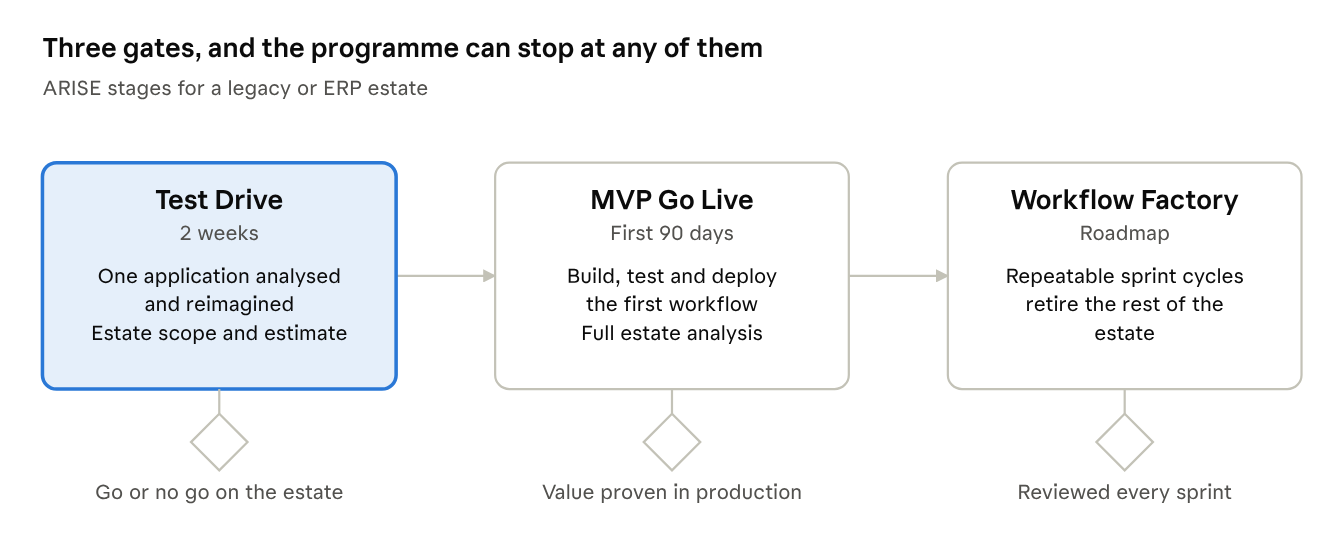
The commitment grows only after the evidence does, so the programme can be stopped at a gate instead of being cancelled mid flight.
What the outcome looks like when the foundation is right
These are published Pega customer results, not Aaseya engagements. They matter because they set the bar for what counts as a result once work is rebuilt as governed workflow rather than wrapped.
- Cisco removed 4 million hours of customer wait time, cut service costs by 80 percent, brought average handle time down from 45 minutes to 20, and took human touch out of up to 93 percent of non value adding work.
- Navistar replaced 13 separate legacy warranty systems, delivered its first minimum loveable product in eight weeks, and the project paid for itself in the first release.
- Siemens Global Business Services grew one order management application to 243 teams across 34 countries, took users from 500 to more than 5,000, integrated 34 ERP entities, and cut customer onboarding from two weeks to 24 hours, with development running five to six times faster.
Aaseya brings the delivery engine to that pattern. We are a Specialized and Government Elite Pega Partner, an AWS Advanced Tier Partner and a Pega Authorised Training Partner, with more than 200 enterprise go-lives at 4.9 out of 5 client satisfaction, ISO 9001, ISO 27001 and Cyber Essentials Plus certification. As part of YASH Technologies, the ERP work sits alongside one of the largest SAP practices in the market, with more than 9,000 consultants.
Where to start
Pick the one application or process whose running cost you would struggle to defend in a board paper, and test the approach on it. Two weeks, one real application, a go or no go at the end. That is a smaller decision than most organisations are currently postponing.
If you are weighing an SAP or ERP transformation, a Notes, mainframe or Java estate, or an AI roadmap that quietly assumes those systems will not be in the way, I am happy to compare notes on what we are seeing across industries and geographies.
- Connect with Shivam Maurya on LinkedIn for a direct conversation.
- Reach the Aaseya team at sales@aaseya.com to scope an assessment or request a private offer through AWS Marketplace.
- Browse the full set of Aaseya offerings on AWS Marketplace, where each one carries its scope, tooling and delivery model in writing.
Sources
| Claim | Source |
|---|---|
| Over 40 percent of agentic AI projects cancelled by end of 2027; legacy integration named as a complexity driver | Gartner press release, 25 June 2025 |
| About 83 billion dollars, 79 percent of planned fiscal 2025 IT spend, on operations and maintenance across 24 CFO Act agencies | GAO 25 107795 |
| Roughly 1.52 trillion dollars of accumulated US software technical debt | CISQ, Cost of Poor Software Quality in the US, 2022 |
| Cisco, Navistar and Siemens GBS outcomes | Pega customer stories |
| Offering scope, tooling and published outcome ranges | Aaseya listings on AWS Marketplace |
Gartner, GAO and CISQ figures are as published on the dates shown and are not Aaseya measurements. Outcome ranges quoted for Aaseya offerings are drawn from our delivery experience and vary by estate, so they are a starting hypothesis for an assessment rather than a commitment.