How structured AI definitions eliminate hallucinations and accelerate process automation development on Camunda 8.7
Vibe coding with definitions is a structured approach to reduce AI hallucinations and improve reliability in Camunda 8.7-based process automation.
The $8.5 Billion Experiment That’s Breaking Production
The vibe coding movement has reached an inflection point. As of early 2026, 92% of US developers have adopted AI coding tools in their daily workflows, and roughly 60% of all new code written is AI-generated.
Nearly 45% of the AI generated code fails security tests and found that it introduced OWASP top 10 vulnerabilities when tested over 100+ LLMs across different coding tasks.
Java —– the most commonly used Camunda 8 backend development, performed worst with ~70% of security failure rate.
For process orchestration platforms like Camunda 8.7, where a single misnamed variable can silently break gateway routing across an entire claim lifecycle, this isn’t just a security problem. It’s an architectural one.
The Problem with Raw Vibe Coding:
The practice of letting AI agents to write your code from NLP – has taken the developers world by storm, this is coined as “Vibe Coding”. Generic AI Prompts produces hallucinated service task types, missing reusable connectors, invented connector configurations, and BPMN variables that don’t exist in your process model ending up with spending more time debugging AI output than developers written code.
The issue isn’t the concept. It’s the absence of definitions and coding rules for the AI agents.
When a developer asks an AI agent to “create a Zeebe worker for document validation,” the agent lacks critical context. It doesn’t know that the correct worker type is ‘validate-upload-documents’, that the process relies on ‘allDocumentsValid’ as the gateway variable, or that IDP extraction is handled via Gemini 2.5 using a Camunda connector template. Without this context, it guesses or relies on prior session patterns – both of which are unreliable in process orchestration – they lead to broken deployments.
The ROI Case: Why Definitions Pay for Themselves
The Camunda ROI Baseline
Before even layering AI into the picture, process orchestration with Camunda already delivers extraordinary returns. Forrester’s Total Economic Impact study of enterprises using Camunda found:
- 408% ROI over three years
- NPV of $112.1 million ($139.5M in benefits vs. $27.5M in costs)
- ~20,000 hours of development effort saved (based on composite model assumptions), worth at least $615,000
- process change cycles reduced significantly (up to ~50% in the study).
- ~$2M savings from legacy system consolidation (in the modeled scenario).
- In specific case studies (e.g., Atlassian), significant reductions in turnaround time have been reported.
The Vibe Coding Multiplier (Without Definitions)
Camunda already delivers a strong ROI baseline , with well documented case studies demonstrating significant efficiency gains and cost saving across enterprises. When AI Assisted development is layered on top, the velocity gains appear compelling on paper:
- 3–5x delivery speed for prototyping and well-understood patterns
- 26% improvement in overall work completion speed
- 51% faster task handling for routine development
- Up to 81%-time savings for API integration, boilerplate, and CRUD operations
- PRs per developer up 20% year-over-year (Cortex 2026 Benchmark)
However, to meet this velocity, AI assistance coding introduced security failure, vulnerabilities, broken processes, and more production incidents for a huge enterprise application.
The Definitions Dividend
This is where “Vibe Coding with Definitions” changes the equation. By constraining AI generation within architectural contracts:
Development velocity stays high, but failure rates drop back to baseline. When an AI agent knows the exact worker type is validate-and-save-claim-wrk (not validateClaim or validate_claim) and knows the output must be claimValidationStatus: “SUCCESS” | “FAILED” (not a boolean), the generated code deploys correctly on the first attempt.
The real ROI math looks like this:
| Metric | Raw Vibe Coding | Vibe Coding + Definitions |
|---|---|---|
| Initial code generation speed | 3–5x faster | 3–5x faster (unchanged) |
| First-deployment success rate | ~55% (hallucinated names, types) | ~90%+ (constrained generation) |
| Debugging time per failed deployment | 30–90 min (tracing BPMN mismatches) | Near zero |
| Security vulnerability rate | 2.74x higher than human code | Approaches human baseline* |
| Process variable naming errors | Frequent (AI invents names) | Rare (names from definition) |
| Connector code duplication | Common (AI generates REST clients for managed connectors) | Eliminated (definition marks boundaries) |
| Time to onboard new developer to project | 2–3 weeks | Days (definition file is the documentation) |
*When definitions include security patterns and anti-patterns explicitly.
What is “Vibe Coding with Definitions”
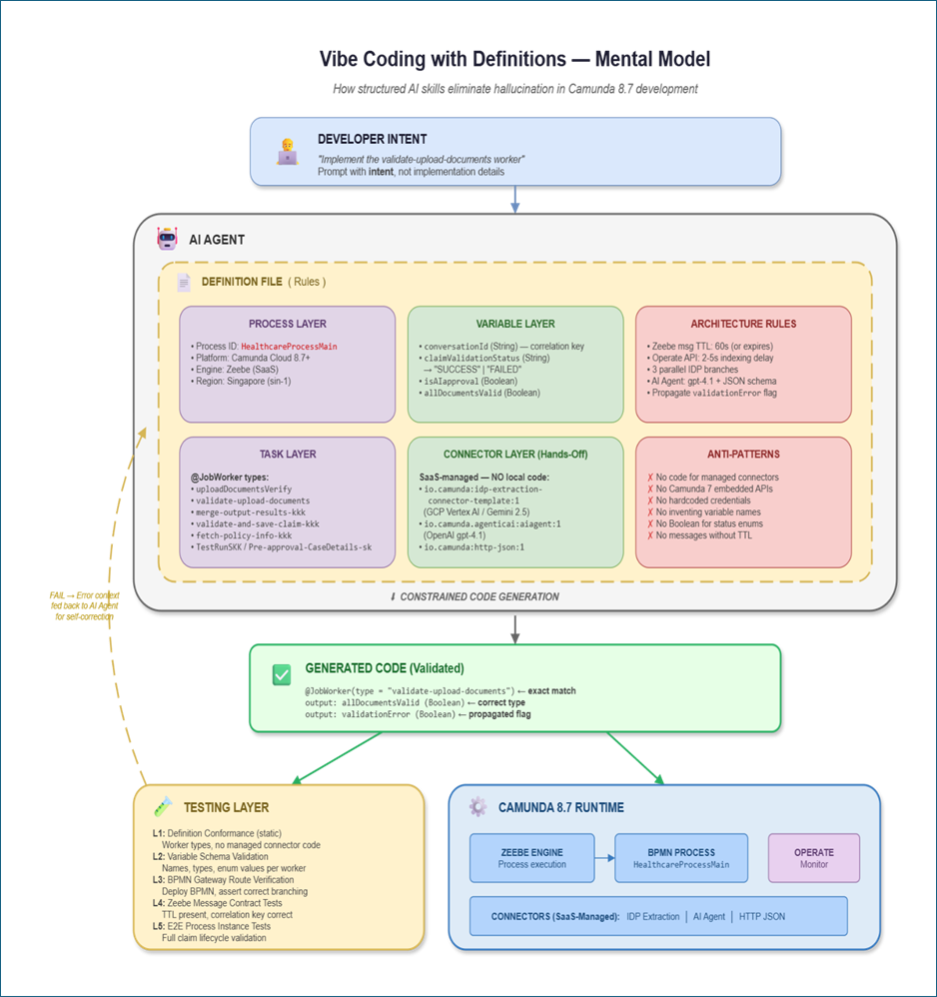
Vibe Coding with Definitions is a structured approach where you equip AI agents with explicit skills, constraints & rules — curated sets of rules, schemas, naming conventions, and architectural constraints specific to your project. Instead of vague prompt instructions, you hand it a definition file that acts as a contract:
- What the BPMN process looks like (task types, gateways, message events)
- How variables flow through the process (names, types, valid values)
- Which connectors and integrations are available (and their exact template IDs)
- Where the boundaries are (what the AI should generate vs. what’s managed by Camunda SaaS)
The AI agent operates within these constraints. It can still “vibe” — generating boilerplate, wiring up patterns, scaffolding implementations —– but now within a controlled and predictable environment.
The Visual Mental Model
Before diving into the definition file structure, it helps to see the entire system as a layered architecture. This is the mental model that separates definition-driven vibe coding from raw prompting:
The Feedback Loop
In practice, the system operates as a continuous loop, not a one-shot generation:
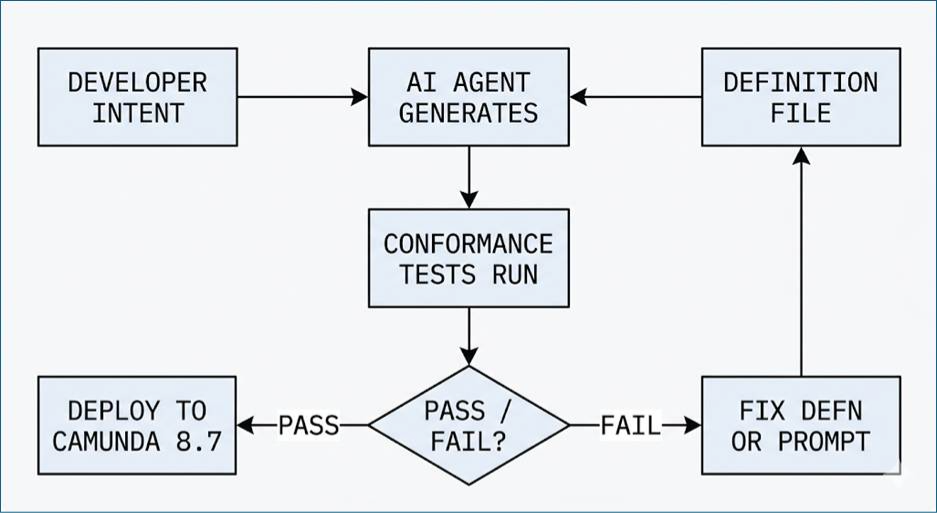
When tests fail, you have two options: fix the prompt (if the business logic is wrong) or update the definition file (if the architectural contract has changed, e.g., a new variable was added to the BPMN). The definition file evolves with the process, not against it.
Vibe coding with definitions provides a structured way to reduce AI hallucinations, improve code reliability, and accelerate development in Camunda 8.7-based process automation systems. By combining AI-assisted development with clearly defined architectural rules, teams can achieve both speed and production-grade stability.
This is where the real implementation begins.