Modernizing SAP ECC Approvals with Agentic AI, Camunda 8 & MCP Connectors
LLMs are everywhere. SAP runs most manufacturing operations. What’s missing is the layer that brings them together safely.
That layer is process orchestration. At Aaseya, we just proved it – an agentic purchase-requisition approval solution built on Camunda 8, live against SAP ECC, for a leading automotive components manufacturer.
Agentic AI on SAP – done the enterprise way. Built by Aaseya on Camunda 8.
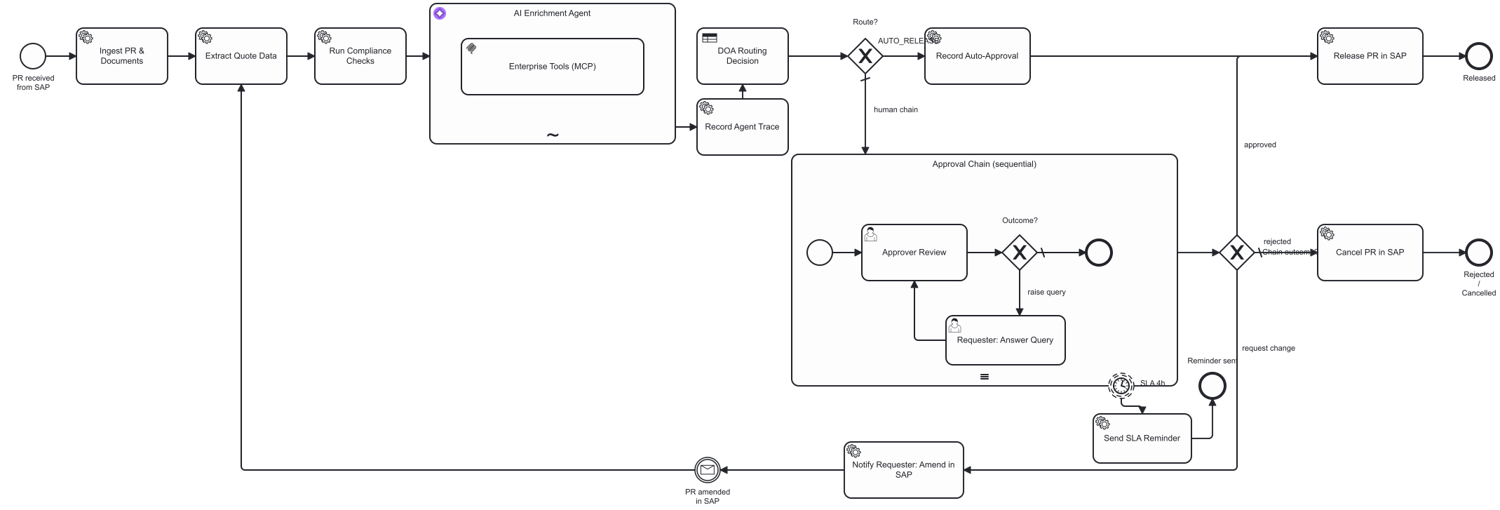
A purchase requisition rises in SAP ECC. Camunda takes it from there:
- AI reads the vendor quote PDFs
- Compliance checks run automatically
- Camunda’s AI Agent investigates over MCP – vendor history, price trends, stock, budgets. 7 tools, discovered at runtime
- A DMN table routes it – policy the business owns and tunes
- Approvers decide on web & mobile, AI evidence in hand
- Release lands back in SAP – idempotent, identity-stamped, hash-chained audit
Why it matters:
- SAP stays the untouched system of record – clean-core friendly
- The Camunda BPMN tasks are implementation-agnostic; swap the ECC endpoints for S/4HANA APIs and the process model, the DMN policy, and the AI tooling all survive unchanged
- Camunda makes AI a governed process step, not a bolt-on
- MCP (open standard): new AI tools with zero redeploy
Low-risk PRs go touchless. Everything else: hours, not days.
SAP as the record. Camunda as the conductor. MCP as the bridge. Aaseya as the builder.
1. The Seven MCP Tools the Agent Uses
Exposed by a single MCP server (Streamable HTTP) in front of enterprise data. All read-only.
| MCP Tool | What it gives the agent |
|---|---|
get_vendor_history |
Delivery performance, past POs, and reliability of the quoting vendors. |
get_price_history |
What the organisation historically paid for this material/asset class. |
get_commodity_trend |
External commodity index movement – contextualises whether a quote is fair. |
get_stock |
Plant-wise stock on hand – e.g., flags that another plant already holds safety stock. |
get_budget |
Cost-centre budget consumption vs. the PR value. |
get_gl_history |
GL account posting history – lets the agent see the same facts the deterministic classifier used. |
get_recent_prs |
Recent similar PRs by vendor/asset – the evidence trail behind split-PR detection. |
2. The Benefit Narrative – What Each Platform Contributes
This is the framing that makes the post promotable: each platform is shown doing the thing its own leadership wants the market to understand. Use these points in comments, reshares, and follow-up posts.
Camunda – the conductor
- Agentic AI as product capability, not custom glue. The AI Agent connector, ad-hoc sub-process, and MCP client are shipped Camunda 8 features – the agent in this solution was configured in the model, not hand-coded. This is the strongest validation signal for Camunda leadership: their agentic-orchestration roadmap working in a real SAP account.
- One model owns the end-to-end. A single BPMN diagram is the source of truth from the SAP event to the SAP write-back – executable, versioned, and visible to operations in real time. No lifecycle logic hiding in code.
- Policy belongs to the business. The delegation-of-authority rules live in a DMN table; auto-release thresholds are client-tunable cells. “Your policy, not our code” is a repeatable sales moment.
- Human-in-the-loop at enterprise scale. Native user tasks reach approvers on web and mobile PWA, with SLA timers, reminders, and query loops modelled – not built as bespoke workflow code.
- SaaS speed to value. A managed Camunda 8 cluster plus out-of-the-box connectors compressed this from an integration programme into a weeks-long build.
SAP – the system of record, undisturbed
- Zero disruption to the ERP core. ECC is untouched: events flow out, idempotent releases flow back in, and approver identities plus AI metrics are stamped into the PR header. SAP remains the audit anchor it has always been.
- Clean-core-aligned modernization. Process innovation happens in the orchestration layer, outside the ERP – exactly the posture SAP advocates for S/4HANA readiness. Customers do not have to choose between innovating and staying upgrade-safe.
- Migration-proof by design. The BPMN tasks are implementation-agnostic; swap the ECC endpoints for S/4HANA APIs and the process model, the DMN policy, and the AI tooling all survive unchanged.
- More value from existing SAP data. Vendor history, price history, budgets, and GL postings already in SAP become active decision evidence instead of passive records.
MCP – the open bridge between AI and the enterprise
- An open standard, not a lock-in. The tool layer is proprietary to no AI vendor and no model. Todays agent runs on Gemini; tomorrows can run on anything – the MCP surface is unchanged.
- Runtime discovery changes the economics. New tools appear to the agent the moment they are deployed to the MCP server – no BPMN change, no agent redeploy, no release cycle. Extending AI capability becomes an afternoon, not a project.
- Governance is structural, not promised. Every tool is read-only; SAP writes happen only through deterministic, idempotent workers. The AI can investigate everything and change nothing.
- Audit-grade AI transparency. Each tool call is recorded into the hash-chained audit log – the AI recommendation is defensible line by line, which is what makes agentic AI acceptable to finance and compliance stakeholders.
- One investment, many consumers. The same MCP server can power a procurement copilot, a finance assistant, or the next agentic process – the tool layer outlives this use case.
Appendix – Full-Size BPMN Diagram